

Being asked to deliver a eulogy is one of life’s greatest honors, but staring at that blank page can feel incredibly intimidating. It’s a heavy responsibility. The key is to remember you’re not trying to write a perfect speech; you’re just trying to tell a true story.
The process really comes down to three things: gathering heartfelt memories, weaving them into a short narrative, and writing it all down in a voice that sounds like you talking about someone you cared for.
The Role of a Heartfelt Eulogy
A eulogy is so much more than a formal speech. Think of it as a final, beautiful gift you’re giving—not just to the person who has passed, but to everyone gathered to remember them. It’s a powerful tool for healing and a way to ensure their story is told with the warmth and authenticity they deserve.
The pressure to “get it right” is real, but shifting your perspective can make all the difference. This isn’t a performance; it’s an act of love. Your words serve a crucial purpose: they help shape the memory of a life, bringing that person’s unique character, their sense of humor, and their quiet kindness into sharp focus for everyone listening.
A Tool for Collective Healing
Never underestimate the impact your words can have on those who are grieving. It’s a shared experience, and your story becomes part of their healing journey. In fact, recent findings show that 82% of funeral attendees felt a well-delivered eulogy significantly helped them process their loss. This really highlights how vital storytelling is for communal grieving.
Hearing stories aloud helps cement the memory and personality of the deceased in a way that simply remembering can’t. If you want to dive deeper into how eulogies aid in the grieving process, eulogygenerator.com offers some great insights.
A eulogy bridges the gap between sorrow and celebration. It acknowledges the pain of loss while simultaneously reminding everyone of the joy and love that person brought into the world. It’s an opportunity to say, “This person mattered, and this is why.”
To help you get started, here’s a quick look at the essential elements that make up a modern, meaningful eulogy.
Core Components of a Modern Eulogy
| Component | Purpose |
|---|---|
| Introduction | Briefly introduce yourself and your relationship to the deceased. |
| A Defining Story | Share a short, specific anecdote that captures their personality. |
| Key Qualities | Highlight 2-3 of their best traits (e.g., humor, generosity, resilience). |
| Shared Impact | Speak about the positive effect they had on you and others. |
| Conclusion | End with a simple, heartfelt farewell or a lasting thought. |
Thinking in these terms can help you build a tribute that feels both complete and deeply personal, offering comfort and a sense of connection to everyone present.
Honoring a Legacy Beyond Words
While your words are the heart of the eulogy, honoring a legacy often extends beyond the service itself. Many people find immense comfort in tangible keepsakes that create a lasting connection to their loved one.
Items like Personalized Memorial Jewelry Thoughtful Keepsakes To Honor Loved Ones can become cherished mementos for friends and family, serving as a physical reminder of a beautiful life long after the funeral has ended.
Gathering Memories for Your Tribute

Before you even think about writing the eulogy itself, your first task is to gather the raw materials. The best tributes are woven from a tapestry of stories, both big and small, and this begins with a bit of gentle detective work. You’re not just listing facts; you’re unearthing the moments that truly defined the person you’re honoring.
Start with your own memories. Don’t feel pressured to instantly recall major life milestones. Instead, let your mind drift to the smaller, everyday moments. What was their go-to coffee order? What song always made them tap their foot? Think about the little quirks and habits that made them, well, them.
Jogging Your Own Memory
Grab a notebook and just start jotting things down. Sometimes, the best way to get the memories flowing is to give yourself a few starting points. Exploring different effective note-taking methods can be a great help here, ensuring you capture every detail as it comes to you.
Try asking yourself a few things:
- What’s my very first memory of them?
- What’s the single funniest story I can tell about us?
- How did they make me feel?
- Is there a particular smell or sound that instantly brings them to mind?
These questions are designed to pull out sensory details. Specifics are always more powerful. For instance, instead of saying, “She was a kind person,” you could recall the time she spent an entire afternoon helping you assemble a piece of furniture you were both completely unqualified to build. That vivid picture tells a much richer story.
Reaching Out for More Stories
Your perspective is crucial, but it’s only one part of their story. One of the most beautiful parts of this process is connecting with others to build a more complete, three-dimensional portrait of the person you’ve lost.
Think about it: modern funerals bring together people from every chapter of a person’s life. You’ll have colleagues, childhood friends, neighbors, and family all in one room. Each person holds a unique piece of the puzzle. Tapping into those different perspectives is what makes a eulogy feel whole and inclusive.
A Quick Tip for Gathering Stories
When you reach out to friends and family, try to avoid the vague question, “Do you have any good stories?” That’s a lot of pressure. Instead, ask something specific. “What’s your favorite memory of him from the annual camping trips?” or “Can you tell me about that time you two got lost on that road trip?” This simple shift makes it much easier for people to access and share a concrete memory.
Finding the Core Theme
Once you’ve collected a handful of memories from yourself and others, take a moment to read through them all. You’re looking for a common thread, a recurring idea that ties everything together. This will become the central theme of your eulogy.
- Was it their unshakable optimism? Maybe every story, in its own way, touches on their ability to find the bright side.
- Was it their quiet generosity? Perhaps multiple people shared stories of small, unannounced acts of kindness.
- Was it their infectious sense of humor? You might find that laughter is a key ingredient in almost every memory shared.
Pinpointing this core theme is a game-changer. It gives your eulogy a strong emotional anchor and transforms a simple list of anecdotes into a cohesive and powerful narrative. This is how you move beyond just remembering what they did and start celebrating who they truly were.
Crafting a Structure That Flows Naturally
Once you have your collection of memories and stories, the next step is to give them shape. This is where structure comes in. Don’t think of it as a rigid formula, but as a gentle guide that helps you move from one point to the next without getting lost. A good structure frees you up to focus on what really matters: delivering your words from the heart.
Ultimately, a eulogy should feel like a story, with a clear beginning, middle, and end. Each section plays a vital role in taking the audience on a journey through the life of the person you’re honoring.
The Opening: Setting the Tone
Your first few sentences are all about connection. Keep it brief and warm. Start by simply saying who you are and how you knew the person. This little detail immediately helps everyone in the room understand your perspective and feel included in the moment.
For instance, you could start with something like, “For those of you I haven’t met, my name is Sarah, and I was David’s little sister—a role I cherished.” It’s simple, direct, and sets the stage for the personal stories that will follow. You’re not just giving a speech; you’re inviting people into a shared memory.
The Body: Telling Their Story
This is the core of your tribute, and the place where you bring your loved one to life. The key here is to avoid a dry, chronological listing of their life events. It’s not a résumé. Instead, focus on 2-3 central themes or qualities that truly defined them. This approach is so much more powerful.
Maybe you decide to talk about their infectious sense of humor, their fierce loyalty to friends, and their quiet love for early morning walks. Each of these themes becomes a small chapter. You can then bring each one to life with a specific, colorful story.
To illustrate their loyalty, perhaps you share that memory of them driving three hours in a rainstorm just to help a friend change a tire. That single story says more than a dozen generic statements ever could.
The most moving eulogies don’t just tell us who someone was; they show us. A specific, vivid anecdote is your most powerful tool for painting that picture.
This visual helps illustrate how these different pieces can come together to form a beautiful, cohesive whole.
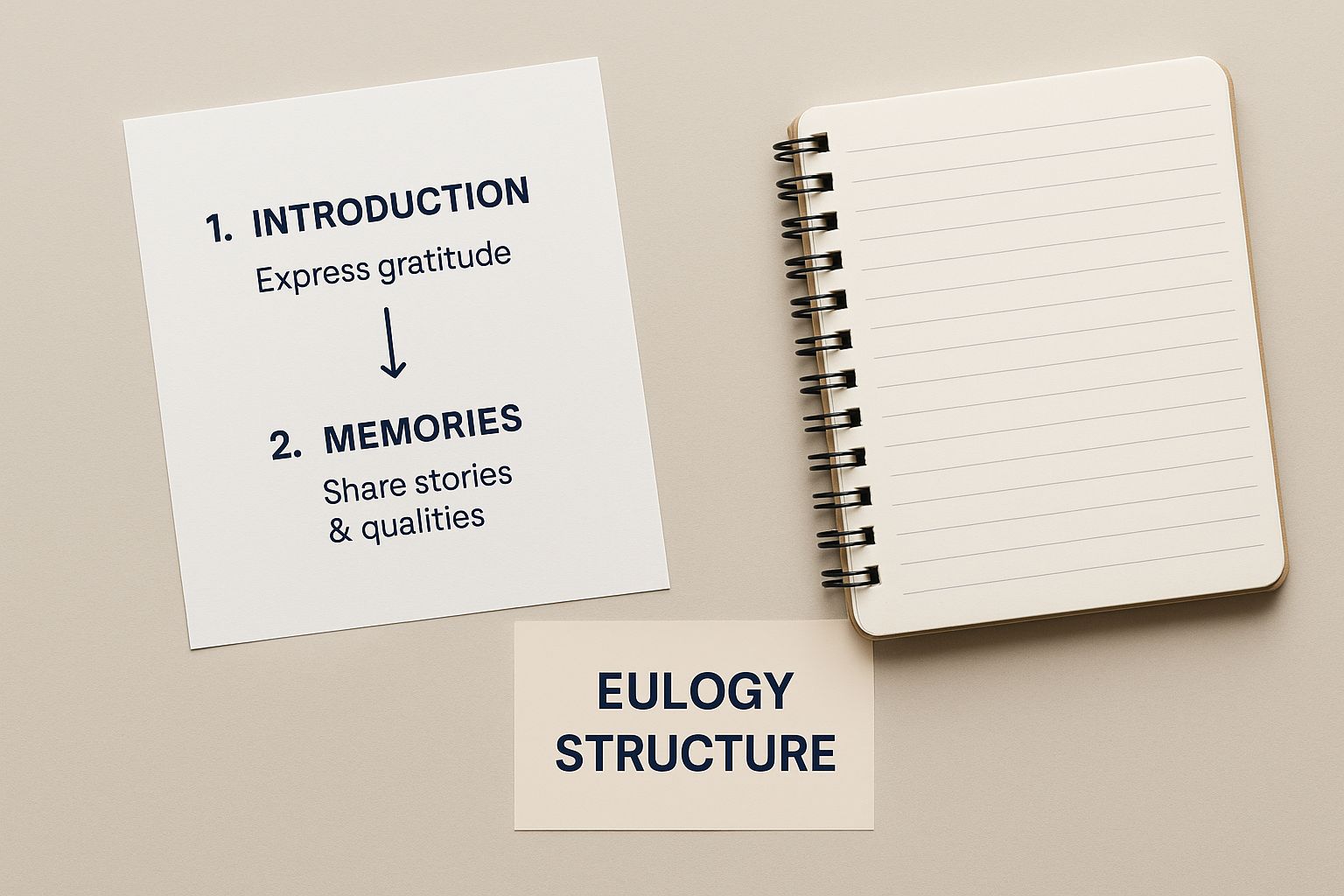
As you can see, a thoughtful structure doesn’t confine your memories—it gives them a sense of purpose and direction.
The Conclusion: A Final, Heartfelt Farewell
Your ending is your chance to bring everything together and offer a sense of peace and closure. It’s where you gently summarize the essence of your message and leave everyone with a comforting final thought.
Circle back to the themes you shared. You might say, “So when we think of her, let’s remember that incredible laugh and her unwavering belief in the good of people. That is the gift she gave us.” This ties everything together beautifully.
Finally, end with a simple, direct goodbye. Something as straightforward as, “We’ll miss you, my friend,” or “Thank you for everything,” carries immense weight. This clear structure ensures your words create a meaningful and lasting tribute.
Eulogy Structure and Flow
Not every eulogy has to follow the exact same path. Depending on your relationship and the stories you want to tell, different organizational approaches might feel more natural. Here’s a quick comparison of a few common structures to help you find the one that fits best.
| Structural Approach | Best For | Example Flow |
|---|---|---|
| Thematic | Highlighting core personality traits or values. Great for capturing the essence of a person. | 1. Open with relationship. 2. Story about their humor. 3. Story about their generosity. 4. Conclude on how these traits live on. |
| Chronological | Telling a life story in a linear way, often for someone who lived a long, eventful life. | 1. Open with relationship. 2. A memory from their childhood/young adulthood. 3. A key story from their mid-life. 4. Conclude with a recent memory or their legacy. |
| Relationship-Focused | Centering the eulogy on your personal connection and shared experiences. Very intimate. | 1. How you met. 2. A story that defines your friendship/bond. 3. How they impacted your life. 4. A direct address to say goodbye. |
Choosing the right structure is less about rules and more about finding the most authentic way to share your story. Pick the one that allows your memories to shine the brightest.
Writing with Authenticity and Heart
The most powerful eulogies don’t sound like speeches at all. They feel like intimate conversations, shared from the heart. When you sit down to write, the real goal is to find your own voice and share stories that feel real, because they are.
Try to let go of any pressure to sound formal or “eloquent.” Just write like you’re talking. Imagine you’re sharing a favorite memory with a close friend over coffee. That genuine, unpolished tone is what will truly connect with everyone listening. This is your story to tell, in your own words.
Balancing Sorrow with Celebration
Grief is a tangled mess of emotions, and a good eulogy has room for all of them. It’s not just okay to mix in moments of lightness and even gentle humor with the sadness—it’s essential.
Remembering their infectious laugh or a funny little quirk doesn’t take away from the weight of the loss. In fact, it does the opposite. It paints a complete, vibrant picture of the person you all loved. Think about a specific memory that truly captures their spirit. For instance, instead of just saying, “She was so generous,” tell the story of how she once gave her favorite coat to a stranger on a cold day. These tangible, joyful memories are gifts to everyone in the room.
A eulogy that balances light and shade gives mourners permission to feel the full spectrum of their emotions. It acknowledges the sorrow of absence while celebrating the gift of having known such a unique individual.
Navigating Your Emotions While Writing
Let’s be honest: writing a eulogy is an emotional marathon. As you sift through old memories, waves of both joy and deep sadness will likely wash over you. That’s completely normal. You have to give yourself the grace to feel it all. This isn’t just an assignment to check off a list; it’s a crucial part of your own grieving process.
If you feel overwhelmed, please, take a break. Step away from the computer. Go for a walk. Just sit with your thoughts for a bit. Writing this tribute is an act of love, and you can’t pour from an empty cup.
- Try writing in short bursts. You don’t have to get it all done in one go. A few sentences here and there is still progress.
- Let the tears come. Crying is a healthy and necessary part of remembering someone you love.
- Focus on just one memory at a time. It makes the whole process feel much less overwhelming.
Throughout this process, your heart is your best guide. If you’re looking for ways to make sure your words sound as natural on paper as they do in your mind, you can find some helpful tips and techniques for natural writing. But ultimately, the best eulogies come from a place of pure, unscripted love.
Practicing Your Delivery with Confidence

You’ve poured your heart onto the page, and now it’s time to prepare to share those words. This isn’t about memorizing a script or putting on a performance. It’s about getting comfortable enough with what you’ve written so you can deliver it with genuine warmth and grace. The goal is simple: to connect with everyone in the room and ensure they feel the love behind your tribute.
The most practical thing you can do is practice reading your eulogy aloud. Words on a page can feel stiff or awkward when spoken. Reading them out loud is the only way to hear the flow, catch any tongue-twisters, and find the natural cadence of your own voice.
This is also your chance to get the timing right. Most eulogies land best when they are between 3 to 5 minutes long. As you read, time yourself at a natural, unhurried pace. If you find you’re running over, you’ll know exactly where you can trim a story or tighten a sentence without losing the core message.
Finding Your Voice and Pace
When you practice, really listen to yourself. Are you speaking clearly? Is your pace steady? Nerves make us talk faster than we realize, so consciously slow yourself down. A deliberate pace gives your words the weight they deserve and gives everyone a moment to take in what you’re sharing.
Pauses are powerful. Don’t be afraid of them. A brief silence before an important memory or after a touching sentiment creates emotional space for the audience. It lets the moment truly sink in.
You don’t need to memorize a single word. In fact, it’s better if you don’t. Just print the eulogy in a large, easy-to-read font. Double-space the lines and add extra space between paragraphs. This little trick makes it much easier to find your place if you get emotional or momentarily lose your train of thought.
Here are a few more things that can make a world of difference on the day:
- Look Up: You don’t need to stare at your notes the whole time. Try to glance up and make eye contact with a few friendly faces. It’s a small gesture that builds a huge sense of connection.
- Let Emotion Happen: If your voice cracks or you feel tears welling up, that’s okay. It’s human. Take a deep breath, have a sip of water, and continue when you’re ready. No one will judge you; they’ll be with you.
- Have a Backup Plan: Ask a close friend or family member to have a copy of the eulogy. Just knowing they are ready to step in if you feel overwhelmed can be an incredible comfort and instantly ease your nerves.
Modern Tools for Gaining Confidence
While standing in front of a mirror is a time-tested method, today’s technology offers some new ways to prepare. You can even find AI-powered platforms that act like a virtual speech coach, giving you feedback you can actually use.
For instance, a platform called Yoodli uses AI to listen to you practice. It can analyze your pacing, point out filler words like “um” or “like,” and even offer feedback on your delivery. It’s like having a private coach who can help you refine your clarity and emotional tone. You can find more about how AI can analyze eulogies on Yoodli.ai.
Ultimately, all this preparation is about one thing: becoming so familiar with the eulogy that you can speak from the heart, not just read from a page.
Answering Your Most Common Eulogy Questions
Even after you’ve gathered your favorite stories, questions always pop up when you actually sit down to write. It’s completely normal to feel a bit lost or unsure about the details. This is an emotional and often confusing process, and you’re not alone in navigating it.
We’ve been helping families with this for years, and we’ve heard it all. Below, I’ve answered some of the questions we get asked most often, hoping to give you the clarity and confidence you need to write something beautiful.
How Long Should a Eulogy Be?
This is probably the number one question people ask. The sweet spot for a great eulogy is between 3 and 5 minutes. When spoken at a natural pace, this usually works out to be about 500 to 1,000 words.
This timeframe gives you enough space to share a few meaningful stories and paint a warm picture of the person you’re honoring. It’s long enough to be substantial but short enough to hold everyone’s attention without making the service run too long.
If you practice reading your draft aloud and find it’s creeping toward the 7-minute mark, that’s your cue to start editing. It’s often the shorter, more focused tributes that leave the most lasting impression.
The goal isn’t to tell their entire life story, but to share a few memories that perfectly capture their essence. The best way to check your timing is to read it aloud, slowly and clearly.
What if I Get Too Emotional to Finish?
This is such a common and understandable fear. The first thing to remember is that showing emotion is not a failure—it’s a beautiful expression of your love. Everyone in that room will understand and empathize.
Still, you can prepare for it. Have a printed copy of your eulogy with you. I always recommend using a large, easy-to-read font and double-spacing the lines. This makes it so much easier to find your place again if you need to look up or pause.
Here are a few other things that really help:
- Have a glass of water at the lectern. A simple sip can give you a moment to collect your thoughts and steady your voice.
- Don’t be afraid to pause. If you feel a wave of emotion coming, just stop. Take a deep breath. No one will rush you.
- Choose a backup speaker. This is my most important piece of advice. Before the service, ask a close friend or family member if they would be willing to step in and finish reading for you. Just knowing you have that safety net can take a huge weight off your shoulders.
Is It Okay to Be Funny in a Eulogy?
Yes, absolutely! If the person you’re remembering had a great sense of humor or a joyful spirit, sharing that side of them is a wonderful gift. Laughter provides a moment of shared relief and connection in a room full of sorrow.
A funny, lighthearted story can be one of the best ways to bring their personality to life for everyone. The key is to make sure the humor is kind, inclusive, and respectful. Stick to stories that everyone can appreciate, and steer clear of inside jokes that might leave people feeling excluded.
The trick is to find a good balance. Weave those lighter moments in with the more sincere, heartfelt ones. This creates a rich, authentic tribute that honors the whole person—celebrating not just their life, but the joy they brought to all of us.
At Jennifer Ashe and Son Funeral Directors, we see writing a eulogy as a profound act of love. Our compassionate team, which includes our own in-house celebrants, is here to offer guidance and support as you craft a tribute that truly honors the unique life of your loved one. For help and advice, please visit us at https://www.jafunerals.co.uk.
Article created using Outrank